
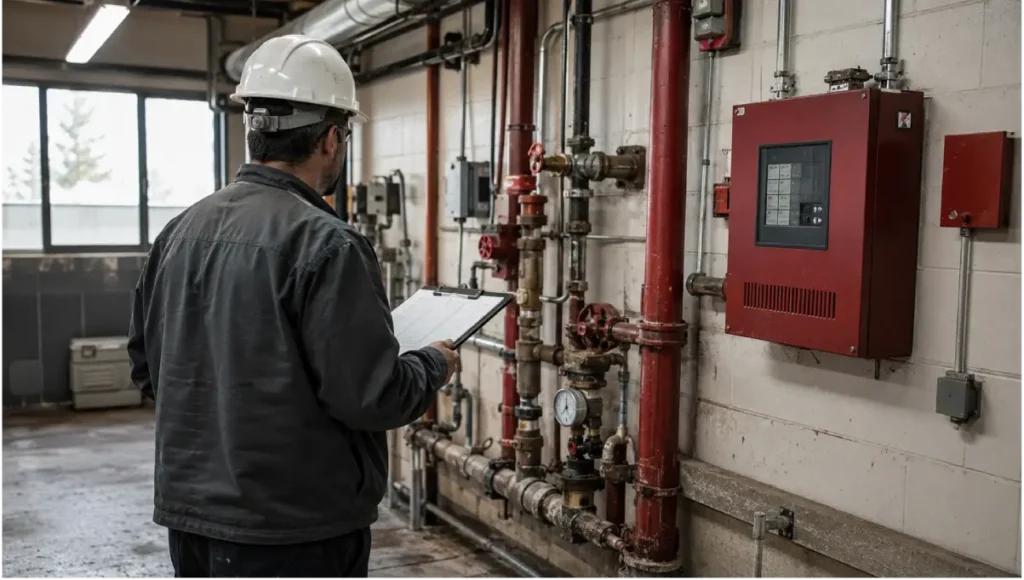
SNF maintenance compliance software tracks preventive maintenance, equipment inspections, work orders, and vendor contracts for a skilled nursing facility (SNF), in the format the Centers for Medicare & Medicaid Services (CMS) and state surveyors expect to see. It has to cover two different regulatory tracks at once the standard health survey and the separate Life Safety Code survey.
Most facilities prepare for one of those tracks and assume it covers the other. A maintenance director pulls a clean preventive maintenance binder for the standard survey, feels confident, and then a Life Safety Code surveyor asks for a completely different document set two weeks later. That gap is where most maintenance-related citations actually come from.
Quick Summary
SNF maintenance compliance software tracks preventive maintenance, work orders, and vendor contracts for two separate regulatory checks: the standard health survey (F-tags, under 42 CFR Part 483) and the Life Safety Code survey (K-tags, under NFPA 101 and NFPA 99). Missing either one creates real citation risk. The software that actually helps is the one that produces survey-ready records for both inside the operations platform your team already uses, not as a separate specialized system bolted on top of it.
Table of Contents
What SNF Maintenance Compliance Software Actually Covers
A computerized maintenance management system (CMMS) is software built around assets and work orders it tracks what equipment exists, what maintenance it needs, and whether that maintenance got done. A work order is the record of one maintenance task performed on one piece of equipment. Preventive maintenance (PM) is maintenance scheduled on a fixed interval, before equipment fails, not after.
For a SNF, that basic CMMS structure has to do more work than it does in a hotel or an office building. The same work order log, PM calendar, and vendor contract file that keep equipment running are also the evidence a surveyor reviews to determine compliance. In a SNF, the maintenance record and the compliance record are the same document.
That is the gap most generic maintenance software falls into. It was never built for a regulated healthcare setting.
What Most Maintenance Compliance Guides Get Wrong About Surveys
Most content on this topic treats “maintenance compliance” as one audit with one set of proof points. A facility can walk into a standard survey completely clean and still take a citation from an entirely separate survey team, reviewing an entirely separate document set, weeks later.
F-Tags and the Standard Health Survey
F-tags are the deficiency codes CMS uses on the standard health survey, tied to 42 CFR Part 483. CMS requires each SNF to be resurveyed within 15 months of its last standard survey, with each state’s average interval held to 12 months or less (Source: 42 CFR §488.308).
Maintenance-related F-tags include F908 (preventive maintenance) and F584 (a safe, clean, and orderly environment). For the full standard-survey documentation picture across every department, see how SNFs organize survey-ready documentation.
K-Tags and the Separate Life Safety Code Survey
K-tags are the deficiency codes CMS uses on the Life Safety Code (LSC) survey a separate survey, run under its own procedure detailed in the CMS State Operations Manual Appendix I, checking compliance with National Fire Protection Association (NFPA) 101 and NFPA 99 instead of 42 CFR Part 483. CMS adopted the 2012 editions of both standards by final rule, effective July 5, 2016 (Source: CMS State Operations Manual Appendix I, citing 81 FR 26871).
Wisconsin’s Department of Health Services tells facilities directly that Life Safety Code surveyors carry a different document request list than health surveyors, and recommends keeping the two record sets apart (Source: Wisconsin DHS, Survey Readiness for Long-Term Care Facilities). That is one state’s guidance, not a universal mandate. But the pattern holds everywhere: the two survey teams do not ask for the same paperwork.
What NFPA 101 and NFPA 99 Actually Require
NFPA 101, the Life Safety Code, sets requirements for building construction, egress, and fire protection systems. NFPA 99, the Health Care Facilities Code, covers medical gas systems, electrical systems, and generator requirements specific to healthcare occupancies. Both are private-sector standards CMS adopted by reference into the Conditions of Participation, not CMS documents themselves which is part of why generic compliance content built around 42 CFR alone tends to miss them.
|
|
Standard Health Survey
|
Life Safety Code Survey
|
|---|---|---|
|
Citation code
|
F-tags
|
K-tags
|
|
Regulatory basis
|
42 CFR Part 483
|
NFPA 101 / NFPA 99
|
|
CMS procedure
|
SOM Appendix PP
|
SOM Appendix I
|
|
What it reviews
|
Care, staffing, environment
|
Building, fire, electrical, medical gas systems
|
F-tags and K-tags are not interchangeable proof points for the same audit, even though most guides treat them that way. A facility can be clean on the standard survey’s F908 preventive-maintenance requirement and still take a K-tag citation on the separate Life Safety Code survey, because that survey team is not reviewing the same records.
What CMS and Illinois IDPH Surveyors Ask to See On-Site
Surveyors reviewing maintenance compliance want to see four record types: a preventive maintenance calendar, a work order log, vendor contracts with current expiration dates, and fire safety inspection records.
Here is what gets missed almost everywhere: what happens when the Illinois Department of Public Health (IDPH) conducts that review specifically. IDPH surveyors work from the same federal F-tag and K-tag framework as any state agency, but the practical test is retrieval speed.
A surveyor asking for the last 12 months of generator test logs is not asking whether the generator was tested. They are asking whether the facility can produce proof of it inside the survey window, not after. For the broader survey-week mechanics under CMS’s current Risk-Based Survey framework, and how retrieval speed factors into every deficiency area, see LTC Apps’ Illinois IDPH survey preparation guide.
Why Vendor Contract Expiration Is a Hidden Compliance Risk
Most maintenance compliance discussions focus on the equipment itself was it serviced, was it inspected, was it logged. Vendor contracts get treated as a paperwork afterthought instead of a compliance risk in their own right.
A lapsed fire alarm monitoring contract does not show up as a missing task on a work order log. It shows up as a missing entry nobody thought to look for, because the maintenance calendar only tracks what is already scheduled, not what stopped being under contract three months ago.
That gap matters because fire alarm monitoring, sprinkler inspection, and generator service are exactly the categories a Life Safety Code surveyor checks. A facility with a perfect PM calendar and an expired sprinkler service contract has a K-tag citation waiting, and the PM calendar will not show it.
If your preventive maintenance program exists only in a technician’s head and a stack of paper work orders, you do not have a maintenance compliance program. You have a maintenance department that has not been asked the right question yet.
How Preventive Maintenance Tracking Actually Prevents Citations
A preventive maintenance calendar does not prevent a citation because the equipment gets serviced on time. It prevents a citation because the record of that service exists in a format a surveyor can find inside the time they are willing to spend looking.
“The tech did it” without a logged date is functionally the same as it not happening, from a surveyor’s perspective. The service is not the compliance event. The retrievable record of the service is the compliance event.
A K-tag citation on equipment that was actually serviced on time is not a maintenance failure. It is a documentation failure wearing a maintenance citation’s number.
CMMS, Compliance Platforms, and Where LTC Apps Fits
There is no single tool that produces both a maintained building and a survey-proof record of it on its own. What matters is whether the record-producing system lives inside the same operations platform your team already runs, or as one more standalone login nobody remembers to check.
LTC Apps’ work order and preventive maintenance tracking software handles exactly this: work orders by status, a monthly preventive maintenance calendar with visit history, vendor contracts with visible expiration dates, and PDF or Excel reports built for regulatory review. It runs inside the same platform that already handles admissions and scheduling, not as a separate system layered on top of one.
That is a deliberate honesty point: it is a tracking system, not an automated tool that scans your records for gaps on its own. The value is not a promise that software catches every problem for you. It is that the four record types a surveyor asks for already live in one place, produced by the team that was doing the work anyway.
That control is boring and it is cheap. One person per discipline, one recurring calendar block, one exported list. It beats an alerting system with no accountability behind it, and you can put it in place this week.
Frequently Asked Questions
It is software that tracks preventive maintenance, work orders, and vendor contracts for a skilled nursing facility in the format CMS and state surveyors require, covering both the standard health survey and the separate Life Safety Code survey.
A K-tag is a CMS deficiency citation issued specifically on the Life Safety Code survey, tied to NFPA 101 and NFPA 99 requirements, not to the 42 CFR Part 483 requirements that produce F-tags on the standard health survey.
F-tags come from the standard health survey and 42 CFR Part 483. K-tags come from the separate Life Safety Code survey and NFPA 101 and NFPA 99. Different survey, different regulatory basis, different documentation request.
CMS requires a standard health survey no later than 15 months after the previous one, with each state’s average interval held to 12 months or less (Source: 42 CFR §488.308). The Life Safety Code survey follows its own CMS procedure and can occur as a separate visit from the standard survey.
Typically a preventive maintenance calendar, a work order log, vendor contracts with current expiration dates, and fire safety inspection records reviewed for completeness and for how quickly the facility can produce them on request.
There is no single answer that fits every facility. For maintenance and life safety specifically, the right tool produces survey-ready work order, PM, and vendor contract records inside the platform your team already uses daily, rather than a separate system your maintenance director has to remember to update.
Is LTC Apps Right for Your Facility?
LTC Apps is built for you if:
- You operate a skilled nursing facility or small regional SNF group managing preventive maintenance, work orders, and vendor contracts.
- You want survey-ready maintenance records without adding a separate, standalone compliance system to your existing operations.
- You are evaluating modular operations software built specifically for SNFs, not adapted from general facilities-management platforms.
This is not the right fit if:
- You need a system that scans completed records for regulatory gaps on its own, with no staff review involved.
- You are looking for a full clinical EHR with physician-facing charting.
- You require an enterprise contract with a dedicated implementation team from day one.
Here is what happens when you request a demo:
- A member of our team reaches out within 1 business day to schedule a call.
- We run a 30-minute walkthrough of the Maintenance module and any other modules relevant to your facility.
- You get pricing specific to your facility size and module selection.
Most facilities have a clear picture of fit and pricing within one week of reaching out.
Common questions before booking a demo: no long implementation timelines most facilities are live on their first module within 2-4 weeks. No minimum facility size we work with single-facility operators and regional groups. If you are mid-contract with another vendor, we can run a parallel evaluation so you are ready to switch at contract end.
If you operate a skilled nursing facility and want survey-ready maintenance records without bolting a separate compliance system onto your existing operations, LTC Apps was built for exactly this.
Most facilities complete their first demo within one week of reaching out.