
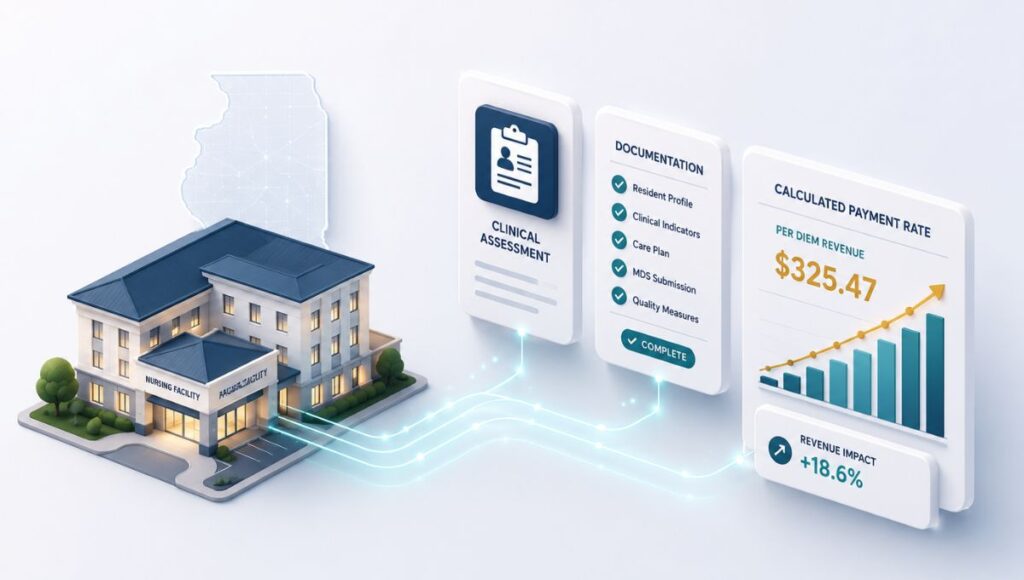
In Illinois, your Medicaid “CMI” is no longer a RUG-IV index. Since the July 1, 2022 payment reform, PDPM case-mix weights derived from the HIPPS code on each resident’s MDS assessment set the nursing component of your Medicaid per diem (Source: HFS Rate Methodology FAQ). If your MDS team is still thinking in RUG categories, they are reasoning about a system Illinois retired.
That distinction is not academic this year. Illinois spent $33.7 billion on Medicaid in 2025, and federal provider-tax limits under OBBBA threaten $3.3 to $5.3 billion in annual losses by the next decade (Source: Skilled Nursing News, Feb 2026). When rates are flat or falling, every legitimately documented case-mix dollar matters more than it did a year ago.
Quick Summary
Illinois pays nursing facilities a facility-specific per diem made of three parts: nursing, support, and capital. Only the nursing component is case-mix adjusted. Since 2022 it uses PDPM weights frozen to CMS’s March 1, 2022 weights not RUG-IV. Each resident’s MDS assessment generates a HIPPS code that sets their nursing case-mix group. Accurate documentation is the only legitimate lever you have.
Table of Contents
How Illinois Actually Pays SNFs for Medicaid Residents
Your Medicaid per diem is not one number with one driver. It is the sum of three separately calculated components: nursing, support, and capital (Source: HFS Long Term Care reimbursement page). Each is built differently, and only one of them responds to resident acuity.
The nursing component is the case-mix adjusted piece. Illinois starts from a statewide nursing base per diem of $92.25, multiplies it by each resident’s PDPM case-mix weight, averages the result across your Medicaid residents, and applies a 1.06 regional wage factor (Source: Ill. Admin. Code §147.310).
Support and capital are different animals. Your facility’s cost reports set them — not how sick your residents are.
This is where popular explanations go wrong, including some AI-generated answers now circulating: they imply capital flexes with acuity. It does not. Capital and support move with your reported costs and the facility’s physical plant, full stop.
|
Component
|
What sets it
|
Case-mix adjusted?
|
|---|---|---|
|
Nursing
|
Base rate x PDPM weight, averaged across Medicaid residents, x 1.06 wage factor
|
Yes
|
|
Capital
|
Facility cost reports and physical plant
|
No
|
Only one of three components moves with case mix.
“Optimizing your CMI” is structurally a nursing-component lever and nothing else. You cannot document your way to a higher capital or support rate, and any strategy that treats CMI as a whole-rate dial misunderstands how Illinois builds the per diem. The ceiling on what documentation can change is the nursing component alone.
On top of these three components sit directed add-on payments: a variable staffing add-on (STRIVE), a quarterly quality incentive, CNA incentive payments, and a Medicaid access payment for high-Medicaid facilities (Source: HFS Rate Calculation Handbook). Those are covered below. Before any of it pays correctly, the eligibility and managed care assignment have to be right, which is its own workflow see verifying Medicaid eligibility and managed care assignment.
What “CMI” Really Means in Illinois Now
Here is what most CMI guides get wrong about Illinois. They describe a RUG-IV case-mix index because that is how nearly every state worked for two decades. Illinois does not work that way anymore.
CMS retired RUG-IV for Medicare in 2019. Illinois ran a RUG-IV nursing component through September 30, 2023, then completed its move to PDPM weights under the 2022 reform (Source: HFS Rate Methodology FAQ). The HIPPS code CMS calculates on each MDS assessment now drives classification, mapping the resident to a PDPM nursing case-mix group.
There is a quirk that catches experienced MDS teams off guard. Illinois froze its PDPM case-mix weights to the active CMS weights as of March 1, 2022, and applies a budget neutrality factor of 0.7858 (the default PA1 and AA1 groups carry a weight of 0.5186). Illinois does not adopt CMS’s annual PDPM weight updates (Source: HFS Rate Methodology FAQ).
The Medicare grouper and the Illinois Medicaid grouper have quietly diverged.
Because Illinois froze its weights to March 2022, the PDPM weights your team watches for Medicare are not the weights paying your Medicaid nursing component. A facility tuning its documentation to the current-year Medicare grouper is optimizing against the wrong weight table for Medicaid. The two systems share a grouper logic but no longer share the numbers underneath it.
The practical takeaway: when an Illinois operator says “our CMI,” they now mean a frozen-weight PDPM nursing case-mix figure, not a RUG-IV index. Getting that vocabulary right is the difference between a billing conversation that lands and one that wastes a meeting.
How Your MDS Drives the Nursing Component
The chain from clinical record to nursing dollars is short and specific. CMS scores each resident’s MDS assessment into a HIPPS code that maps to a PDPM nursing case-mix group and weight. Illinois multiplies the $92.25 state wide base rate by that weight, averages across your Medicaid residents, and applies the 1.06 wage factor to produce your facility nursing component (Source: Ill. Admin. Code §147.310).
A missing or delinquent assessment defaults the resident to the lowest-acuity group, AA1, at a weight of 0.5186. That default is the single most expensive documentation gap in the system. A resident with real clinical complexity who lands in AA1 — because the assessment was late or incomplete — is paid as the lowest-acuity resident in the building, regardless of the care delivered.
The fields that move the PDPM nursing group are the ones your team already touches: NTA comorbidities, the clinical conditions and extensive services that drive nursing acuity, and Section GG functional coding. Document those completely and the nursing component reflects the resident. Leave them thin and the grouper has nothing to work with — and no downstream billing correction recovers what the assessment failed to capture.
This is exactly why coding accuracy at intake is a revenue function, not a clerical one. Tools that surface diagnoses from the clinical record before the assessment locks, like AI-assisted ICD-10 code analysis, exist to close the gap between the care delivered and the codes captured.
The Add-On Layer: STRIVE Staffing and Quality Incentives
Beyond the three rate components, Illinois layers on directed payments that reward staffing and quality. These are real money and they are mechanical you either hit the thresholds or you do not.
The STRIVE staffing add-on pays a per diem based on your reported nurse staffing hours divided by a case-mix-expected target, both pulled from the CMS Provider Information file. Payment runs on a tiered scale: $9.00 per day at 70%, scaling to $38.68 per day at 125% and above, and $0 below 70% (Source: HFS Staffing Per Diem Scale, eff. Oct 1, 2024).
Note one trap: the 70% figure is a staffing ratio threshold, not a Medicaid utilization rate. Some summaries get this wrong.
The quality incentive distributes a $17.5 million statewide pool each quarter, allocated by each facility’s quality-weighted share of Medicaid days and keyed to its CMS long-stay quality measure star rating (Source: HFS Rate Methodology FAQ). A higher long-stay star rating pulls a larger slice of that fixed pool.
The nursing component and STRIVE pull your MDS data in opposite directions.
Raising documented acuity raises your nursing component but that same acuity raises the case-mix-expected staffing denominator inside STRIVE, so your reported hours must clear a higher bar to earn the same tier. Document higher acuity without staffing to match, and you can lift one payment while suppressing another. The two systems read the same assessments and reward different things.
STRIVE runs on the PBJ hours you already report, so the accuracy of that submission is part of this rate see PBJ staffing compliance. And because Illinois state ratios now carry full enforcement weight after the federal staffing rule rescission, the staffing floor underneath all of this is a live compliance question covered in Illinois CNA staffing ratios.
How to Optimize Illinois CMI Without Compromising Care
There is a clean line between optimizing and gaming, and it runs through one question: did the acuity already exist in the resident? If yes, capturing it accurately is your job and your revenue. If no, coding it is fraud waiting for an audit.
Optimization in Illinois is documentation integrity, not aggressive coding. In practice, it means:
- Completing the hospital packet at intake so the admitting clinical picture is whole
- Setting the ARD deliberately, not defaulting to day five before therapy and NTA conditions are documented
- Coding Section GG to reflect what the resident actually can and cannot do
- Running a verification pass before the assessment locks, so delinquent records never default a high-acuity resident into AA1
An Illinois operator running 20 facilities described their revenue gains this year as coming from capturing clinical events accurately in documentation, not from rate increases (Source: Skilled Nursing News, Feb 2026). That is the whole strategy in one sentence, from someone living it.
We built LTC Apps Medical Code Analysis to surface ICD-10 diagnoses from the clinical record so the nursing-component documentation is complete before the MDS locks, rather than reconstructed after a denial.
Hard truth
You cannot raise your Illinois Medicaid CMI. You can only document the acuity that was already there. Anything past that is an audit finding waiting to happen.
What the 2026 Rate Environment Means for Your CMI
This matters more this year because the money around it is under pressure. Illinois faces a multibillion-dollar Medicaid funding gap as OBBBA tightens the provider-tax cap from 6% to 3.5% by 2032, with state analyses projecting $3.3 to $5.3 billion in annual losses when lost federal matching funds are counted (Source: Skilled Nursing News, Feb 2026). Operators report Illinois Medicaid rates have stayed roughly flat over the past year.
When the base rate is not growing, the only revenue you control is the case-mix accuracy of the residents already in your building. A flat-rate environment does not make CMI optimization optional. It makes it the last lever still in your hands and it raises the cost of every under-documented assessment.
Frequently Asked Questions
There is no single statewide figure, because the per diem is facility-specific. It is the sum of a nursing component (built from a $92.25 statewide base rate times each resident’s PDPM case-mix weight, adjusted by a 1.06 wage factor), plus support and capital components set from your cost reports, plus add-on payments (Source: Ill. Admin. Code §147.310). Two facilities with identical buildings can be paid differently based on resident acuity and staffing.
PDPM. Illinois moved its Medicaid nursing component from RUG-IV to PDPM case-mix weights, completing the transition by October 2023. The weights are frozen to the CMS weights active as of March 1, 2022, and classification comes from the HIPPS code on each MDS assessment (Source: HFS Rate Methodology FAQ).
Each Medicaid resident’s MDS assessment produces a HIPPS code that maps to a PDPM nursing case-mix group and weight. The facility nursing component is the average of those resident-specific weighted amounts, built on the $92.25 base rate and adjusted by the 1.06 regional wage factor (Source: Ill. Admin. Code §147.310).
By documenting the acuity that already exists, accurately and on time. Complete the hospital packet at intake, set the ARD deliberately, code Section GG and NTA conditions correctly, and verify assessments before they lock so no resident defaults to the lowest-acuity AA1 group. You cannot legitimately raise CMI beyond the resident’s actual clinical picture.
A per diem payment that rewards nurse staffing relative to a case-mix-expected target. It pays $9.00 per day at a 70% staffing ratio, scaling to $38.68 per day at 125% and above, and $0 below 70% (Source: HFS Staffing Per Diem Scale, eff. Oct 1, 2024).
Who This Is For
LTC Apps is built for you if:
- You operate a skilled nursing facility or small Illinois SNF group and want your Medicaid nursing component to reflect the acuity you actually care for
- You want to close MDS documentation gaps before assessments lock — not after a rate is set
- You are evaluating operations software built for SNFs, not adapted from hospital or home health platforms
This is not the right fit if:
- You are looking for a full clinical EHR with physician-facing charting
- You need software for assisted living only, with no skilled nursing component
- You require an enterprise contract with a dedicated implementation team from day one
What Happens After You Request a Demo
- A member of our team reaches out within one business day to schedule a call.
- We run a 30-minute live walkthrough of the modules most relevant to your facility.
- You get pricing specific to your facility size and module selection.
Most facilities have a clear picture of fit and pricing within one week of reaching out.
Common questions before booking a demo: No long implementation timelines most facilities are live on their first module within 2 to 4 weeks. No minimum facility size we work with single-facility operators and regional groups. If you are mid-contract with another vendor, we can run a parallel evaluation so you are ready to switch at contract end.
Stop Leaving Documented Acuity on the Table
If you operate an Illinois skilled nursing facility and your Medicaid nursing component does not reflect the residents you actually care for, the gap is almost always in documentation and it is fixable. LTC Apps was built for exactly this.