
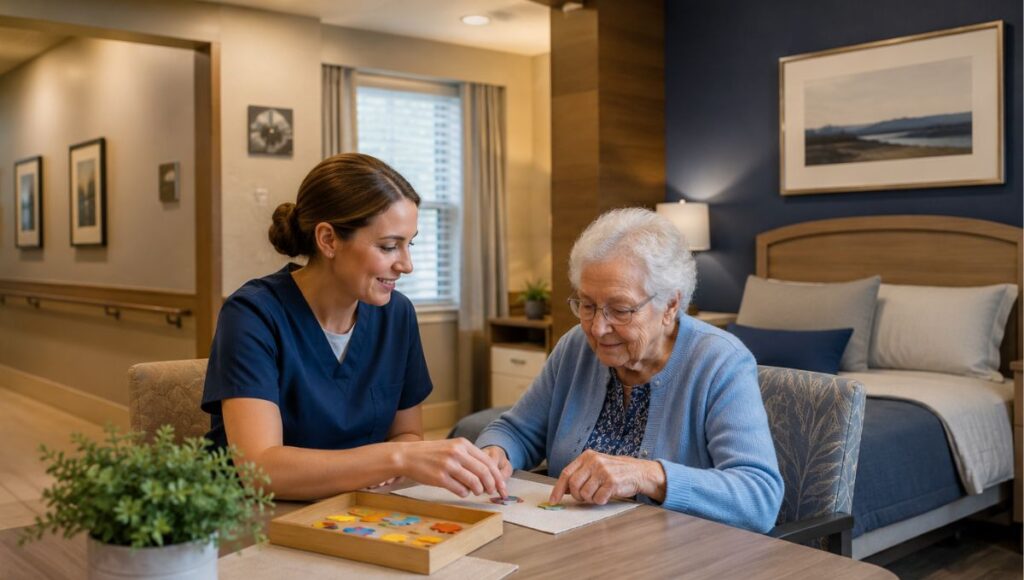
Most skilled nursing operators treat memory care as something to manage around — a clinical challenge, a staffing burden, a category of residents that makes operations harder. The facilities pulling ahead financially have flipped that thinking entirely. They have looked at the same resident population and seen a specialty service line with stronger reimbursement, growing demand, and almost no real competition in most markets.
The business case for memory care in skilled nursing is not complicated. Most operators just have not looked at it directly.
Table of Contents
The Residents Are Already There Whether You Have a Program or Not
Here is the reality most SNF administrators already know but rarely say out loud: 41.1% of nursing home residents are diagnosed with Alzheimer’s disease or another form of dementia and in long-stay nursing homes that figure rises to 57.6% (CDC / Rosewood Nursing, 2025).
That means the average SNF is already a memory care facility for nearly half its census. In long-stay units, it is the majority. The dementia residents are there. The question is not whether to serve them it is whether the facility is organized, trained, and reimbursed to serve them well.
Now consider this: fewer than 5% of all nursing home beds in the United States are in dedicated dementia special care units (NIH / Alzheimers.gov). Fewer than 5% of beds are purpose-built for a population that makes up 40 to 57% of the census.
That is not a clinical gap. That is a market gap and for operators willing to build into it, it is a significant competitive advantage.
The Demand Is Only Going One Direction
The demographics behind memory care demand are not a forecast. They are already in motion.
7.2 million Americans aged 65 and older now have Alzheimer’s disease the first time that figure has exceeded 7 million, up from 6.9 million just one year prior (Alzheimer’s Association, 2025). The first Baby Boomers turned 80 in 2026. The demographic wave that drives memory care demand is just beginning.
On the supply side, NIC MAP estimates a 550,000-unit memory care shortfall by 2030 representing a $275 billion development gap. The inventory of purpose-built memory care beds is growing below 1% annually the slowest pace in two decades of tracking.
Demand is accelerating. Supply is not keeping up. In most markets, the SNF operator who builds a credible memory care program in the next two to three years will have that referral relationship locked in for a decade before a competitor catches up.
The Financial Case Is Stronger Than Most Operators Realize
The clinical argument for memory care is clear. The financial argument is what most operators miss.
Under Medicare, annual SNF spending per person with Alzheimer’s or another dementia averages $3,890 compared to $392 for residents without dementia. That is nearly ten times higher Medicare SNF spending per person (Alzheimer’s Association Facts and Figures, 2024). These residents require more skilled nursing services, more care coordination, and more clinical documentation and Medicare’s payment model is designed to reflect that.
Beyond Medicare, memory care carries a significant private pay premium. Monthly memory care costs nationally range from $6,690 to $7,908 per occupied bed a 20 to 30% premium over standard assisted living rates. Facilities that build dedicated memory care programs in the SNF setting access both streams: higher Medicaid cognitive reimbursement rates in states that recognize cognitive status in their rate-setting, and private pay families who are actively searching for purpose-built dementia care environments and willing to pay for them.
The dual revenue opportunity higher Medicare reimbursement for complex dementia residents plus private pay for families seeking specialized environments is what operators who have built memory care programs are actually experiencing. It is not a theory. It is a revenue model that works.
Why Most Operators Shy Away And Why That Is the Opportunity
If the financial and demographic case for memory care is this clear, why are fewer than 5% of nursing home beds purpose-built for it?
Because building a memory care program is genuinely hard. It requires staff training investment not a one-time orientation but an ongoing cultural shift in how the team understands and responds to dementia. It requires environmental changes secured units, wayfinding design, programming adapted to cognitive function. It requires a willingness to manage behaviors that general SNF staff are not trained for and often uncomfortable with.
Staff resistance is real. Families of non-dementia residents sometimes resist being placed near memory care residents. The training investment is significant upfront before the revenue follows.
But here is the thing: every one of those barriers is exactly why competitors are not moving. The operators who solve the training and culture problem who invest in staff education, rename and reframe care roles, and build a team identity around memory care create a clinical and reputational moat that is genuinely hard for a competitor to replicate in 12 months.
The difficulty of building a memory care program is not a reason to avoid it. It is the reason it is still an open opportunity in most markets.
What It Takes to Run Memory Care Well Operationally
The clinical side of memory care gets most of the attention. The operational side is where facilities leave money on the table.
The most common financial leak in memory care is cognitive assessment documentation. Under PDPM, cognitive impairment directly impacts the SLP payment component but only if the assessment is completed correctly. If the Brief Interview for Mental Status (BIMS) MDS Section C is not completed, the resident is automatically classified as cognitively intact. That means a facility caring for a resident with moderate to severe dementia gets paid as if that resident has no cognitive impairment at all.
This happens more often than it should. Incomplete BIMS assessments, missed staff assessment fallbacks, and unvalidated cognitive scores are among the most common MDS errors in facilities that have not built a disciplined documentation process around their dementia population.
Accurate MDS coding and clinical documentation ensures that every cognitive condition is captured, every BIMS score is completed and validated, and every reimbursement dollar tied to cognitive complexity is actually claimed. When a facility is running 40 to 57% dementia census and losing the SLP component on a significant portion of those residents due to incomplete assessments, the revenue impact is substantial.
Beyond MDS accuracy, care planning and clinical documentation for memory care residents has to be more detailed, more frequent, and more defensible than for a general SNF population because these residents are higher acuity, higher scrutiny, and higher reimbursement. The documentation has to match the care.
Facilities that manage this well with integrated clinical documentation, accurate MDS coding, and consistent assessment workflows are the ones capturing the full financial value of their memory care census.
Frequently Asked Questions
Yes. SNF-based memory care serves residents who require a level of skilled nursing care wound care, medication management, complex clinical monitoring in addition to dementia-specific support. Assisted living memory care serves residents whose primary need is supervision and daily living support. SNFs that build memory care programs are serving a more clinically complex population and are reimbursed accordingly under Medicare and Medicaid.
Yes. Annual Medicare SNF spending for residents with Alzheimer's or another dementia averages $3,890 per person compared to $392 for residents without dementia. That nearly 10x difference reflects the higher skilled nursing, therapy, and care coordination needs of dementia residents. Under PDPM, cognitive impairment also impacts the SLP payment component directly but only when the MDS Section C cognitive assessment is completed accurately.
Staff training and documentation accuracy are the two most common operational gaps. Memory care requires a different clinical culture staff trained in dementia-specific communication, behavior management, and person-centered care. On the documentation side, incomplete BIMS assessments are the most frequent reimbursement error in facilities with high dementia census, because an uncompleted assessment results in the resident being classified as cognitively intact regardless of their actual condition.
Start with your own census data what percentage of current residents have a dementia diagnosis, and what percentage likely have undiagnosed cognitive impairment? Then look at your hospital referral partners and ask what they are struggling to place. If your market has a shortage of purpose-built dementia beds and your hospital discharge planners are having difficulty placing complex dementia patients, that is your signal.
Memory care is already the clinical reality inside most skilled nursing facilities. The residents are there. The reimbursement rewards complexity. The demand is growing faster than the supply of appropriate beds.
The operators who reframe memory care from a burden into a specialty service line and build the training, documentation, and clinical infrastructure to support it are finding both the census stability and the revenue premium that general SNF operations increasingly cannot provide.
The market gap is real and it is open. The question is who in your market closes it first.
If you want to see how LTC Apps supports accurate MDS documentation, cognitive assessment workflows, and clinical coding for memory care populations request a demo and we will walk you through it.