
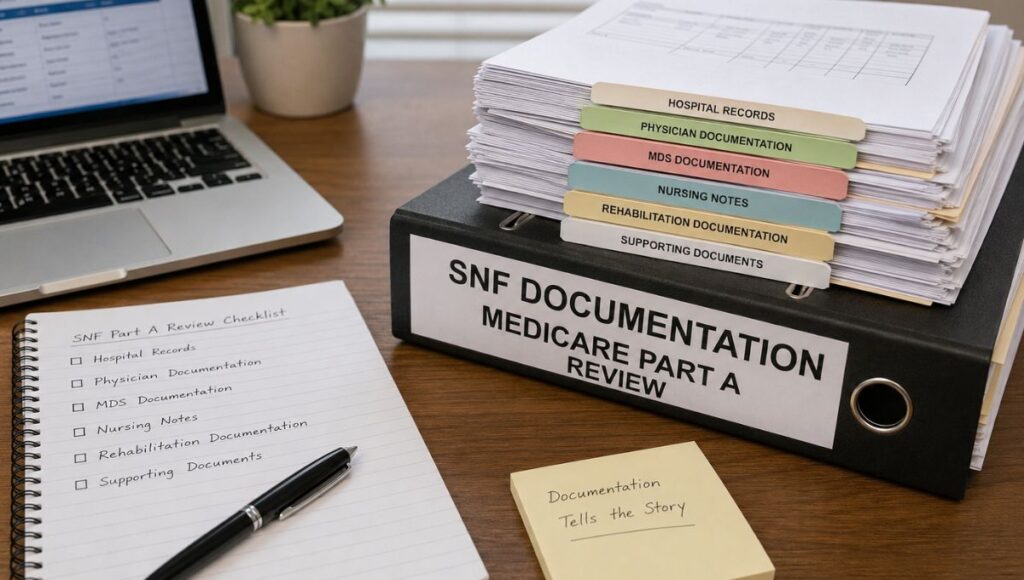
A Medicare reviewer working a Part A skilled nursing claim checks six categories of documentation: hospital records, physician documentation, the MDS (Minimum Data Set, the standardized clinical assessment CMS requires for every Part A stay), nursing notes, rehabilitation records, and a set of supporting documents most checklists treat as an afterthought. If a requirement isn’t visible in one of these categories, the reviewer cannot conclude it was met.
An unmet requirement is a denial, regardless of what actually happened at the bedside. SNF documentation isn’t a filing exercise. It’s the mechanism the facility gets paid through. The chart has to prove, on paper, what the care team already knows to be true.
Quick Summary
Medicare reviewers check six documentation categories on a Part A SNF claim: hospital records, physician documentation, MDS, nursing notes, rehabilitation documentation, and supporting records like signature logs and required coverage notices. The MDS hard copy gets cross-checked against the clinical record and the billing submission; the facility gets paid at whichever rate the documentation actually supports, not the rate entered on the assessment. Missing signatures, therapy notes that log gym time instead of skilled minutes, and certification dates that don’t match the record are the three failure points that cause most denials. The sections below cover what belongs in each category and why.
Table of Contents
What Medicare Reviewers Are Actually Checking For
Reviewers don’t check documentation randomly. They work a sequence: confirm patient eligibility, including the qualifying hospital stay and benefit days available, then verify 30-day transfer window compliance or a documented exception.
From there, they check that Patient Driven Payment Model (PDPM) billing categories match the number of days billed and that the assessment reference date (ARD) was set appropriately. Interrupted stays affecting billing dates come next, followed by physician certification timing, and finally whether the documentation supports skilled services as reasonable and necessary.
Each step depends on the one before it. A reviewer doesn’t move to medical necessity if eligibility documentation is already incomplete.
The deeper mechanics of any single step, including how the certification timeline works and how the pre-submission Triple Check process catches mismatches before a claim goes out, are covered in full in the certification and recertification deadlines guide. This post maps all six categories the reviewer checks; those posts carry the depth on each step.
Hospital Records: The Foundation Reviewers Check First
The hospital packet has to include the transfer sheet, history and physical, discharge summary, surgical report if applicable, and pertinent medication and fluid administration records. These records validate what’s entered on the MDS. A reviewer checking Section I diagnoses or a HIPPS code traces it back to the hospital documentation that supports it.
HIPPS code (Health Insurance Prospective Payment System code) determines the facility’s PDPM payment rate for the stay, built from five separate MDS classification decisions. NTA (Non-Therapy Ancillary) is one of those five components, driven by comorbidities documented in the resident’s diagnosis history.
Most facilities treat the hospital packet as an eligibility gate: confirm the qualifying stay happened, file the records, move on. But the same packet is where NTA comorbidities get missed.
A missed diagnosis at intake doesn’t show up as a missing document. It shows up ninety days later as a suppressed PDPM rate that no downstream coder can recover, because the classification window has already closed.
When billing flags reimbursement lower than a resident’s actual clinical complexity, the gap usually traces back to what didn’t make it into the hospital packet at admission, not to anything billing did wrong later.
Physician Documentation: The Non-Negotiables
The physician file needs orders specifying the need for SNF care, a history and physical, an admission assessment, progress notes, and, where applicable, orders or intent documentation from a non-physician practitioner (NPP: a nurse practitioner or physician assistant acting under physician supervision). Every one of these has to carry a signature and a date.
CMS is specific about what counts as a valid fix for a missing signature. Per the Medicare Program Integrity Manual, Chapter 3 Section 3.3.2.4, a missing signature on most medical record entries can be corrected with a signature attestation statement. Orders are the exception: an unsigned order cannot be fixed retroactively with an attestation the way other record types can. CMS’s July 2025 signature requirements guidance confirms the same standard.
Certification and recertification statements belong here too, including delayed certification documentation with a physician’s stated reason and signature. The certification and recertification deadlines guide covers the timing mechanics, the facility-employment signatory restriction, and the pre-populated dating trap in full.
MDS Documentation: Why the Hard Copy Has to Match Three Other Sources
A reviewer doesn’t take the locked MDS assessment at face value. The hard copy gets cross-checked against what’s submitted to the repository, against the billing claim, and against the supporting clinical documentation underneath it.
If those don’t agree, the facility gets paid at whichever rate the documentation actually supports, not the rate entered on the assessment. Most facilities treat the locked MDS as the final word on payment. It isn’t.
The MDS assessment is not evidence. It’s a claim. The nursing notes, therapy notes, and billing record are what either back that claim up or take it apart.
The reviewer’s job is to test the MDS against those three sources. The lowest common denominator among them is what gets paid.
The sections that draw the closest scrutiny carry the most direct payment impact: Section A (dates), Section B (cognitive and sensory status), Section GG (functional abilities), Section K (swallowing, nutrition, and fluid intake), and Section M (skin conditions and medications). These sections build the HIPPS code discussed above. The compliance documentation guide covers the full RAI Manual picture: correction protocols, version requirements, and the 2026 CMS data validation program.
Nursing Documentation: The Record That Has to Match the MDS
Nursing documentation includes the admission assessment, all nurse’s notes, the medication administration record, and treatment notes. This category is the primary evidence supporting several of the MDS sections above.
A reviewer checking Section GG functional scoring or Section M skin documentation checks it against what nursing actually wrote down, not just what’s checked on the assessment. A resident’s nursing notes and MDS entries have to tell the same story.
When they don’t, when the notes describe a lower level of assistance than what’s scored on the assessment, for instance, the mismatch becomes the reviewer’s basis for paying at the lower-documented rate.
Rehabilitation Documentation: Where “Gym Time” Becomes a Denial
Therapy documentation requires the initial evaluation and plan of care, and this applies regardless of which dates the review covers. Even reviewing day 60 of a stay still requires the day-one initial evaluation in the file; there’s no exception for records outside the review window if they establish the original plan of care.
Progress notes are required at minimum every ten treatment days, completed by the treating therapist. Daily treatment notes need to document actual skilled treatment minutes, not total time the resident spent in the therapy area. Rest time between exercises doesn’t count toward the skilled minutes total, even during a scheduled therapy session.
A note logging fifty-five minutes of treatment and a note logging fifty-five minutes in the therapy gym describe two different things to a reviewer, even for the identical session. The first supports the HIPPS code. The second raises the question of how much of that time was actually skilled intervention versus supervised rest, and that question gets resolved against the facility, not for it.
Any significant change in functional status requires a reevaluation, separate from the routine ten-day cadence. Skip it, and the plan of care documents a baseline that no longer matches the resident.
Additional Required Documentation
A handful of supporting records round out the file. Signature logs or attestation statements are required for any handwritten documentation, particularly where a signature is illegible.
A Skilled Nursing Facility Advance Beneficiary Notice of Non-coverage (SNF ABN, CMS-10055) needs to be confirmed as appropriately issued if one was given to the resident. A QIO (Quality Improvement Organization) letter, issued when a resident requests a fast appeal of a coverage determination through the Beneficiary and Family-Centered Care QIO, belongs in the file if one exists.
Plans of care need to be signed and dated by the clinicians who completed them. None of these are large documents individually, but a reviewer working an ADR treats a missing signature log the same way as a missing physician order: a category the facility didn’t fully close out.
Why Most Documentation Checklists Get the Failure Points Wrong
Most checklists treat every document category as equally weighted: collect everything on the list, submit it, done. That’s not how denials actually happen. Three specific failure patterns account for most of them, and they’re not evenly distributed across the six categories above.
MDS data that doesn’t match the underlying clinical documentation is the first. Therapy notes logging total gym time instead of documented skilled minutes is the second. Physician certifications with pre-populated dates that fall out of compliance when a physician signs early or late is the third.
A complete chart is not the same as a defensible chart. Presence was never the actual test. Consistency was.
Checklists that only confirm presence, whether the document is there or not, miss this entirely. The documents can all be present and the claim can still fail, because the numbers inside them told different stories.
Who LTC Apps Is Built For
LTC Apps is built for you if you operate a skilled nursing facility and want to reduce documentation gaps before they turn into ADR findings, without replacing your entire clinical system to do it. It’s also a fit if you’re evaluating modular operations software built specifically for SNFs, not adapted from hospital or home health platforms.
This isn’t the right fit if you’re looking for a full clinical EHR with physician-facing charting, or a system built for assisted living without a skilled nursing component.
Here’s what happens when you request a demo: a member of our team reaches out within one business day to schedule a call. We run a 30-minute walkthrough of the modules most relevant to your facility, and you get pricing specific to your facility size and module selection. Most facilities have a clear picture of fit and pricing within one week of reaching out.
On the documentation side, LTC Apps Admissions tracks document completion per patient on the intake record, shown as a ratio: 26 of 28 required documents on file, with the missing two flagged. It’s scoped to the admissions intake file rather than the full chart. It closes the most common gap: documents that were supposed to be collected and weren’t.
No long implementation timelines: most facilities are live on their first module within 2 to 4 weeks. No minimum facility size. If you’re mid-contract with another vendor, we can run a parallel evaluation so you’re ready to switch at contract end.
If you operate a skilled nursing facility and want fewer surprises the next time an ADR letter arrives, LTC Apps was built for exactly this.
Most facilities complete their first demo within one week of reaching out.
Frequently Asked Questions
Six categories: hospital records supporting the qualifying stay, physician documentation including signed and dated orders and certifications, the MDS with supporting clinical documentation, nursing notes, rehabilitation documentation, and supporting records like signature logs and the SNF ABN if one was issued.
The transfer sheet, history and physical, discharge summary, surgical report if applicable, and medication and fluid administration records that validate what's entered on the MDS.
At minimum every ten treatment days, completed by the treating therapist, with additional reevaluations required whenever the resident's functional status changes significantly.
Skilled treatment minutes document the actual clinical intervention provided. Total time in the therapy area includes rest periods between exercises, which don't count toward the skilled minutes a reviewer uses to support the HIPPS code.
Presence isn't the test. Consistency is. If the MDS, nursing notes, therapy notes, and billing submission don't tell the same story, the reviewer pays at whichever rate the documentation actually supports, which can be lower than what was billed.
Most missing signatures can be corrected with a signature attestation statement per CMS Program Integrity Manual Section 3.3.2.4. Orders are the exception: an unsigned order cannot be corrected retroactively with an attestation the way other record types can.