
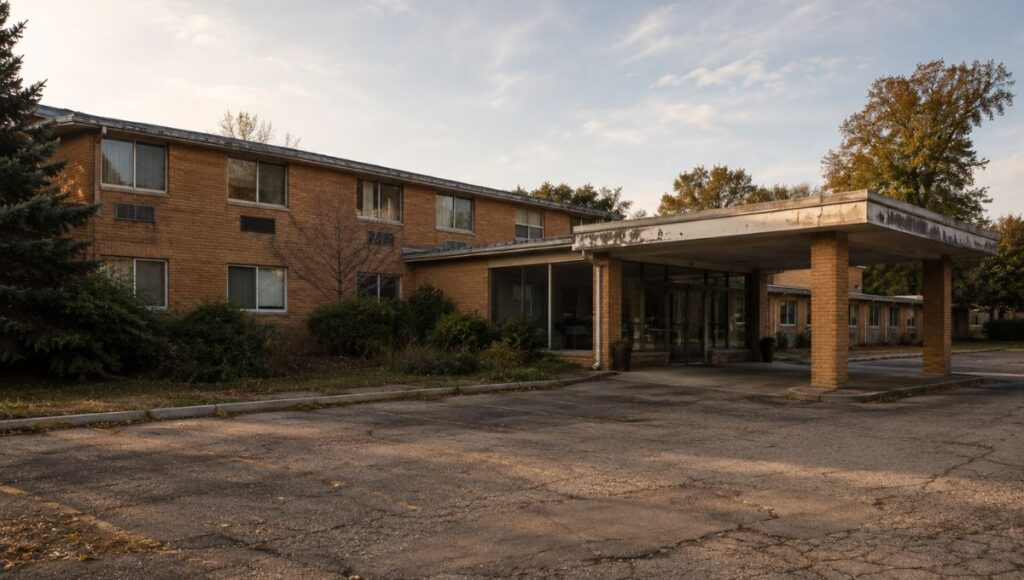
The COVID pandemic did not create skilled nursing facility infrastructure problems. It revealed them.
Multi-bed rooms where residents share space with strangers. Shared bathrooms that make infection control nearly impossible. HVAC systems designed for a different era. Physical plant layouts built around nursing station models from the 1970s. These were not new problems in 2020. They were problems that existed for decades quietly generating deficiencies, quietly driving infection spread, quietly making good clinical care harder than it needed to be.
COVID made them impossible to ignore. And when the emergency passed, Washington moved on. The buildings did not get better. The reimbursement policy did not change. The federal conversation returned to staffing ratios and quality measures as if the physical environment where those ratios and measures are supposed to be met is somehow irrelevant.
It is not irrelevant. It is the foundation. And for most of the SNF industry, it is crumbling.
Table of Contents
What the Average SNF Building Actually Looks Like
Before getting into policy, it is worth being clear about what the physical reality is for most residents and staff in skilled nursing facilities today.
A study of nursing home rooms found that only about one quarter of nursing home rooms in the United States are private meaning three-quarters of SNF residents are sharing a room with at least one other person, usually a stranger, with minimal privacy and shared bathroom facilities (ATI Advisory / Access to Capital in the Nursing Home Industry Databook, 2022). That is not a minor design preference issue. It is an infection control problem, a dignity problem, and increasingly a competitive problem as newer facilities and assisted living communities offer private room environments that older SNF buildings simply cannot match without significant renovation.
The physical design of most SNF buildings was not conceived for modern infection control requirements. Centralized nursing stations, shared dining areas, multi-resident rooms, and shared bathrooms are architectural features that made operational and financial sense when they were built and that COVID demonstrated are fundamentally incompatible with managing highly contagious respiratory illness in a vulnerable population.
The facilities that managed COVID best were the ones with private rooms and the physical capacity to cohort residents and isolate exposures. The ones that struggled most were the ones where the building itself made every infection control protocol harder to execute.
The Demand Is Growing The Building Stock Is Not
The infrastructure problem would be serious enough if demand were stable. It is not stable. It is accelerating and the building stock is moving in the opposite direction.
More than 3,000 new nursing homes may need to be built by 2030 just to maintain current ratios of beds to elderly population as the baby boomer generation ages into peak long-term care need. At the same time, the supply of skilled nursing beds contracted by over 25,000 units between 2021 and 2025 closures, consolidations, and conversions that reduced total licensed bed capacity even as the demographic wave built toward its crest (Senior Housing Business / Ainvest, 2025).
The result is a market where demand is projected to nearly double over the next two decades while the existing infrastructure is aging, contracting, and in many cases operating in buildings that were constructed before the current nursing home regulatory framework even existed.
Washington has not responded to this with a meaningful capital investment program. There is no federal infrastructure grant for SNF building modernization. There is no targeted Medicaid capital component that helps operators convert multi-bed rooms to private rooms. The HVAC system in a SNF built in 1974 does not have a dedicated reimbursement pathway for replacement. The physical plant is essentially treated as the operator’s problem — in an industry where 45% of facilities are operating at a loss and median margins are 1.8%.
That is the gap. It is significant, it is structural, and Washington is not looking at it.
The Technology Infrastructure Is Equally Behind
The physical plant is not the only infrastructure problem. The technology infrastructure that supports clinical operations in many skilled nursing facilities is years behind the rest of the healthcare system and the gap has real consequences.
In 2018, only 22% of nursing home electronic health record systems could send data externally. Only 41% could receive data. And just 12% could integrate data with other organizations (ATI Advisory, 2022). Those numbers have improved since 2018 but the baseline they represent tells you how far behind the starting point was, and how much ground still needs to be covered.
Healthcare interoperability is now a regulatory requirement in hospitals and physician practices. The 21st Century Cures Act’s information blocking provisions, the CMS Interoperability and Patient Access Final Rule, and hospital electronic health record certification standards have all pushed acute care settings toward connected, interoperable systems. Skilled nursing facilities have been largely left out of those mandates.
The practical consequence is a referral pipeline that still relies heavily on fax machines, phone calls, and manually transmitted documents creating friction at exactly the moment when speed and accuracy of clinical information transfer are most critical to resident safety. A hospital discharge planner sending a referral packet to an SNF that cannot electronically receive and integrate the clinical record is not a workflow efficiency problem. It is a patient safety problem.
Why Older Buildings Get More Deficiencies
Building age is not just a comfort issue. It is a compliance issue.
Data from ATI Advisory’s 2022 nursing home industry databook shows that older nursing home facilities those that have been in operation longer have significantly higher average health and fire deficiency counts than newer facilities. The relationship is consistent and not subtle. A building built in 1968 with the infection control infrastructure of 1968 will generate more infection control citations than a building built in 2010 with modern design standards regardless of how skilled and committed the clinical staff operating it are.
This matters because survey citations are not just a quality indicator. They are a financial indicator. Citations lead to plans of correction. Plans of correction lead to resource expenditure. Serious citations lead to civil monetary penalties. And under the revised F641 guidance, repeated documentation failures across assessments can lead to OIG referrals.
The building is not neutral. It is a risk factor and for operators running facilities in aging physical plants, that risk is structural in a way that no staffing improvement or documentation upgrade can fully offset.
Washington Does Not See It And Why That Matters
The federal policy conversation about skilled nursing facilities runs almost entirely through three channels: staffing, reimbursement rates, and quality measures. That conversation is important. But it consistently leaves out the physical environment where staffing delivers care, where reimbursement is supposed to support quality, and where quality measures are either achievable or not based on whether the building supports the care model.
Medicare and Medicaid reimbursement rates do not include a meaningful infrastructure capital component. The nursing facility cost reports include depreciation, but depreciation on a building that was fully depreciated 20 years ago does not generate the capital needed to convert shared rooms to private rooms or replace a 50-year-old HVAC system with a modern air filtration system.
The AHCA and state associations have advocated consistently for infrastructure capital programs. Some states have created targeted Medicaid capital add-on payments or bond programs for nursing home modernization. But at the federal level, the conversation has not moved in a meaningful direction.
The result is an industry where the operators who can access capital through HUD financing, private lenders, or strategic partnerships are slowly separating from those who cannot and where the building stock continues to age without a policy mechanism to systematically address it.
What Operators Can Do
The policy gap is real. Operators cannot wait for Washington to solve it.
The most accessible near-term infrastructure investment is technology modernization and it is also the one with the fastest and most measurable return. Integrated clinical documentation platforms that connect MDS workflows, care planning, incident reporting, and billing in a single system do not require building renovation. They require a technology decision and they immediately reduce the documentation friction, interoperability gaps, and compliance risk that aging technology infrastructure creates.
For physical plant, HUD Section 232 financing remains the best available tool for operators who qualify particularly the new Express Lane track for facilities with strong survey records and stable financials. State bond programs and strategic partner co-investment are worth exploring for specific clinical program builds.
Phased private room conversion converting shared rooms to private rooms one unit at a time as capital allows is the most common approach operators take to physical plant modernization without a full building replacement. It is slow, but it moves the census mix toward the higher-margin private room environment that referral partners and families increasingly expect.
The building problem is not going away. And neither is the demand for the care that happens inside it. The operators who treat infrastructure as a long-term strategic priority not just a maintenance expense are the ones who will still be operating competitive, viable facilities in 2040.
Frequently Asked Questions
Older buildings were designed with physical layouts and infrastructure that do not meet modern infection control, resident privacy, or care delivery standards. Multi-bed rooms, shared bathrooms, centralized HVAC, and outdated electrical and plumbing systems create structural barriers to compliance that clinical staff cannot fully compensate for through training and procedures alone. Data shows that older facilities have significantly higher average deficiency counts than newer ones a pattern consistent across health and fire safety citations.
The federal reimbursement and policy conversation about skilled nursing facilities focuses almost exclusively on staffing ratios, payment rates, and quality measures. There is no meaningful federal capital grant program for SNF physical plant modernization. Medicare and Medicaid depreciation allowances on fully depreciated buildings do not generate the capital needed for private room conversion or HVAC modernization. Some states have created targeted capital add-on payments or bond programs, but at the federal level this remains an unaddressed gap.
Technology infrastructure modernization integrated clinical documentation, interoperable EHR systems, and connected billing platforms is the most immediately accessible infrastructure investment with the fastest measurable return. It does not require building renovation, can be implemented on an operating facility without disruption, and directly addresses the interoperability gaps and documentation friction that create both survey risk and revenue leakage. For physical plant, HUD Section 232 financing and phased private room conversion are the most commonly used approaches.
Only about 25% of US nursing home rooms are currently private. As assisted living communities and newer SNF facilities offer private room environments, older multi-bed room facilities face a growing competitive disadvantage in attracting private pay and managed care referrals particularly for residents and families who have a choice. The private room conversion gap is both a quality and a market positioning problem that will become more pronounced as the overall demand for long-term care increases over the next two decades.
The infrastructure problem in skilled nursing is real, it is structural, and it is not on Washington’s agenda in any meaningful way. The buildings are aging, the technology is behind, the physical plant design is incompatible with modern infection control standards, and the reimbursement system does not provide the capital to fix it.
That does not mean operators are without options. Technology modernization is accessible now and pays back quickly. HUD financing is the best available tool for operators who qualify. Strategic partnerships fund clinical programs. Phased private room conversion moves the needle over time.
But the starting point is acknowledging what the problem actually is not just managing its symptoms on the survey report. The building is either an asset or a liability. Operators who treat it as a strategic variable rather than a maintenance line item are the ones building facilities that will still be competitive when the demographic wave crests.
If you want to see how LTC Apps supports technology infrastructure modernization from integrated clinical documentation to connected billing workflows request a demo and we will walk you through it.