
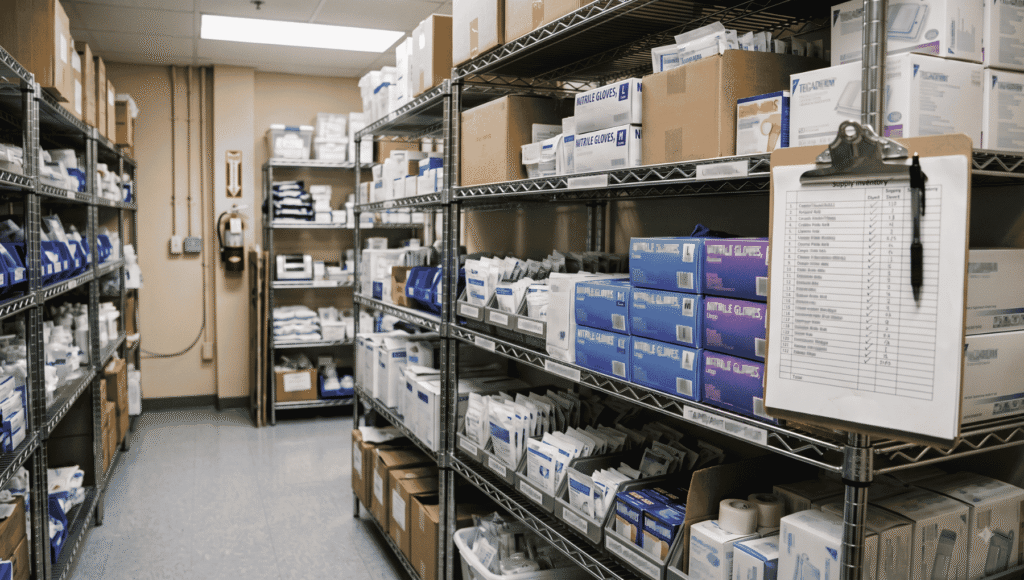
Skilled nursing facilities run three separate supply operations at once clinical supplies for direct resident care, office supplies for administration, and maintenance supplies for the physical plant. Most facilities manage all three the same way: verbally, inconsistently, and without a record anyone can produce later.
SNF inventory management software is a system that tracks supply requests, purchase orders, and vendor information for a skilled nursing facility across these three categories. It replaces verbal requests and paper logs with a structured, searchable record one that matters just as much during a state survey as it does during a busy shift change.
This guide covers what SNF inventory management actually involves: PAR levels, daily clinical supply ordering, purchase order workflow, vendor contract tracking, and the compliance documentation angle most software vendors never mention.
Quick Summary
SNF inventory management software organizes supply requests across clinical, office, and maintenance categories with priority levels and department assignment. Most small-to-mid facilities do not need automated reorder thresholds they need structured visibility into what was requested, by whom, and when. PAR levels are set manually based on census and usage patterns, not calculated by software. Surveyors check supply documentation directly, particularly under infection control review. The right system for a 60-150 bed SNF looks different from a hospital warehouse system, and buying the wrong one wastes budget on features nobody uses.
Table of Contents
What SNF Inventory Management Actually Covers
SNF inventory management spans three distinct supply categories that rarely get separated in generic healthcare inventory content. Clinical supplies cover resident care items wound care products, incontinence supplies, PPE (personal protective equipment).
Office supplies cover front-office and administrative needs. Maintenance supplies cover facility upkeep, from HVAC filters to plumbing parts.
Treating these as one undifferentiated “inventory” is the first mistake most facilities make. A nursing unit running low on gloves is a clinical and compliance issue. A front office running low on printer paper is not.
Software that does not separate these categories buries urgent clinical requests under routine administrative ones. The second layer is priority and ownership. Every supply request needs three things attached to it: who requested it, which floor or resident it serves, and how urgent it is.
Without that structure, requests get submitted verbally in hallways and forgotten by the next shift.
PAR Levels in a Skilled Nursing Facility
What a PAR Level Is
A PAR level (Periodic Automatic Replenishment level) is the minimum quantity of a supply item a facility keeps on hand before triggering a reorder. It is a facility-set threshold, not a fixed industry number a 150-bed SNF with a heavy wound care census needs a different PAR level for dressing supplies than a 60-bed facility with a lighter clinical mix.
How SNFs Set PAR Levels by Department
Clinical PAR levels are usually set by nursing leadership based on average daily census, current resident acuity, and historical usage during the last two to three ordering cycles. Maintenance and office PAR levels are typically set by the administrator or purchasing coordinator, with far less volatility than clinical supply.
The math itself is simple: average daily usage multiplied by the number of days until the next delivery, plus a safety buffer for delivery delays or a sudden census spike. What is not simple is keeping that number accurate as census and acuity shift.
Most facilities set a PAR level once and never revisit it. That number is already wrong within two quarters census shifts, acuity changes, and a threshold built for last year’s resident mix quietly becomes either a chronic shortage risk or wasted storage space.
Why Most Small-to-Mid SNFs Manage PAR Manually
Automated PAR tracking where software recalculates thresholds and triggers reorders on its own exists in hospital and large health-system inventory systems. For a facility running three supply categories and a handful of vendors, that level of automation is often unnecessary complexity, not a missing feature.
Why Most Inventory Software Oversells What Small SNFs Need
Most inventory management software marketed to healthcare is built for hospital-scale operations: barcode scanning at the bedside, RFID shelf sensors, automated reordering tied to consumption algorithms. None of that matches how a 60-150 bed skilled nursing facility actually orders supplies.
This matters because the mismatch is expensive twice over. Facilities pay for automation features they never configure, and they still lack the one thing they actually needed a clear, categorized record of who requested what supply, for which resident or floor, at what priority.
The real operational problem in most small-to-mid SNFs is not inventory forecasting. It is visibility. A department head submits a supply request verbally to whoever is walking by, and three days later nobody can say whether it was ordered, received, or forgotten.
Structured request tracking solves that problem directly. Predictive reorder algorithms solve a problem most SNFs at this size do not have.
Daily Clinical Supply Ordering Workflow
Clinical supply requests need to move faster than office or maintenance requests, because a shortage on the nursing unit becomes a resident care issue within hours, not days. A functioning workflow captures the item, quantity, requesting floor or resident, and priority level at the moment the need is identified not at the end of shift when someone remembers to write it down.
Most facilities that struggle with supply shortages do not actually have a purchasing problem they have a request-visibility problem. The supply gets ordered eventually. What breaks down is knowing it was ordered at all, which leads departments to duplicate requests, over-order out of uncertainty, or run out entirely because everyone assumed someone else already flagged it.
A structured supply ordering platform gives every department a consistent place to submit requests with priority flags, so a high-priority wound care item does not sit in the same queue as a routine office supply reorder. LTC Apps Orders organizes requests into clinical, office, and maintenance categories, each with priority levels and direct links to preferred suppliers like Amazon, Medline, and Adva Care.
Purchase Order Management for SNFs
What a Compliant Purchase Order Record Needs
A usable purchase order record for an SNF tracks the item, quantity, requesting department, approving staff member, order status, and date. That sounds basic, but most facilities relying on verbal requests and email chains cannot reconstruct this record after the fact.
That failure surfaces the moment billing, a surveyor, or an auditor asks for it. The purchase order process itself follows a predictable sequence: request submission, priority assignment, approval, order placement with the vendor, and status tracking through to receipt.
Each step needs a timestamp attached to it, because “we ordered it” and “we can prove when we ordered it” are two very different positions to be in during an audit. Paper-based purchase order systems fail for a specific, recurring reason: the paper moves with a person, not with the request.
If that person is out sick or the paper gets misplaced between departments, the order simply stalls with no visibility into where it stopped.
Vendor Management and Contract Tracking
Vendor management in an SNF context covers two different things that often get confused: day-to-day supply ordering relationships (Amazon, Medline, and regional distributors) and formal facility vendor contracts (equipment leases, service agreements, maintenance contracts).
Contract-level vendor tracking agreement terms, contract expiration dates, and payment frequency matters most for facility service vendors, not routine supply orders. Missing a contract renewal date creates either a lapse in service or an unplanned auto-renewal at unfavourable terms, both avoidable with a simple tracked record.
LTC Apps supports vendor contract tracking through the Maintenance module, which logs vendor agreements, contract expiration dates, and payment frequency alongside work orders and preventive maintenance schedules. That gives administrators one place to see when a vendor contract needs renewal attention.
Inventory Documentation for Surveys and Billing Alignment
Here is what actually happens during an infection control survey: surveyors interview staff directly about supply availability. Federal guidance instructs surveyors to confirm that PPE and other supplies necessary for infection prevention are readily accessible in resident care areas, and to ask staff how those supplies are ordered when they run low (Source: CMS-20054, Infection Prevention Control and Immunization guidance).
Infection prevention and control was the most frequently cited deficiency category in long-term care in 2025, cited under F880 (Source: CMS survey data, cited via Medline Strategies). A facility that cannot produce a clear record of what clinical supplies were on hand, and how staff request replacements, is not just operationally disorganized it is exposed during exactly the survey window where that gap gets documented as a deficiency.
Billing alignment is the quieter version of the same problem. When clinical supply usage does not match what is documented in the resident’s chart, that mismatch surfaces during a Triple Check review or a Medicare Part A claims audit, not before.
A supply record tied to the resident and floor at the time of request closes that gap before it becomes a billing discrepancy. For facilities building out their broader compliance documentation practices, inventory records are one piece of a larger audit-readiness picture that includes staffing records, maintenance logs, and clinical documentation working together.
How LTC Apps Supports SNF Supply Operations
LTC Apps Orders gives every department clinical, office, and maintenance a structured way to submit and track supply requests, with priority levels, floor and resident assignment, and direct links to preferred suppliers. It is a request and tracking tool, not an automated reorder system, which matches how most small-to-mid SNFs actually manage supply operations day to day.
Vendor contract details live in the Maintenance module, keeping renewal dates and payment terms visible alongside work orders and preventive maintenance schedules. Together, these modules give administrators and department heads one operational record instead of scattered paper logs, verbal requests, and separate spreadsheets.
Facilities managing front-desk and visitor documentation alongside supply and maintenance records get the same benefit from LTC Apps Visitor Management a consistent, structured log instead of a paper sign-in sheet, built for the same audit-readiness standard as supply and maintenance tracking.
Frequently Asked Questions
A PAR level is the minimum quantity of a supply item a facility keeps on hand before reordering. Facilities set PAR levels by department based on average usage, census, and delivery timing there is no universal number across facilities.
Most small-to-mid SNFs track medical supplies through a structured request system that captures item, quantity, requesting floor or resident, and priority level, rather than automated barcode or RFID tracking used in hospital-scale systems.
A compliant SNF purchase order process includes request submission, priority assignment, approval, vendor order placement, and status tracking through to receipt with a timestamp at each step for audit purposes.
Surveyors, particularly under infection control review, interview staff about whether necessary supplies like PPE are readily available and how they are reordered when running low (Source: CMS-20054).
Not necessarily. Vendor contract tracking agreement terms, expiration dates, payment frequency can be managed within a facility operations platform alongside maintenance and supply tracking, rather than as a standalone system.
No specific software is required. What matters for survey and audit purposes is that the facility can produce a clear, accurate record of supply availability and ordering practices when asked.
Who This Is For
LTC Apps is built for you if:
- You operate a skilled nursing facility or small regional SNF group managing clinical, office, and maintenance supply requests across departments
- You want structured visibility into supply requests and vendor contracts without adopting a hospital-scale automated inventory system
- You are evaluating modular operations software built for SNFs, not adapted from hospital or warehouse platforms
This is not the right fit if:
- You need automated PAR recalculation and algorithm-driven reorder triggers
- You are looking for a full clinical EHR with physician-facing charting
- You require enterprise-scale barcode or RFID inventory tracking across a multi-facility warehouse system
What Happens After You Request a Demo
- A member of our team reaches out within 1 business day to schedule a call
- We run a 30-minute live walkthrough of the Orders and Maintenance modules, tailored to your facility’s supply and vendor structure
- You get access to pricing specific to your facility size and module selection
Most facilities have a clear picture of fit and pricing within one week of reaching out.
Common Questions Before Booking a Demo
No long implementation timelines most facilities are live on their first module within 2-4 weeks. No minimum facility size we work with single-facility operators and regional groups. If you are mid-contract with another vendor, we can run a parallel evaluation so you are ready to switch at contract end.
If you operate a skilled nursing facility and want to stop losing time to verbal supply requests, missing vendor renewal dates, or unclear inventory documentation LTC Apps was built for exactly this.