
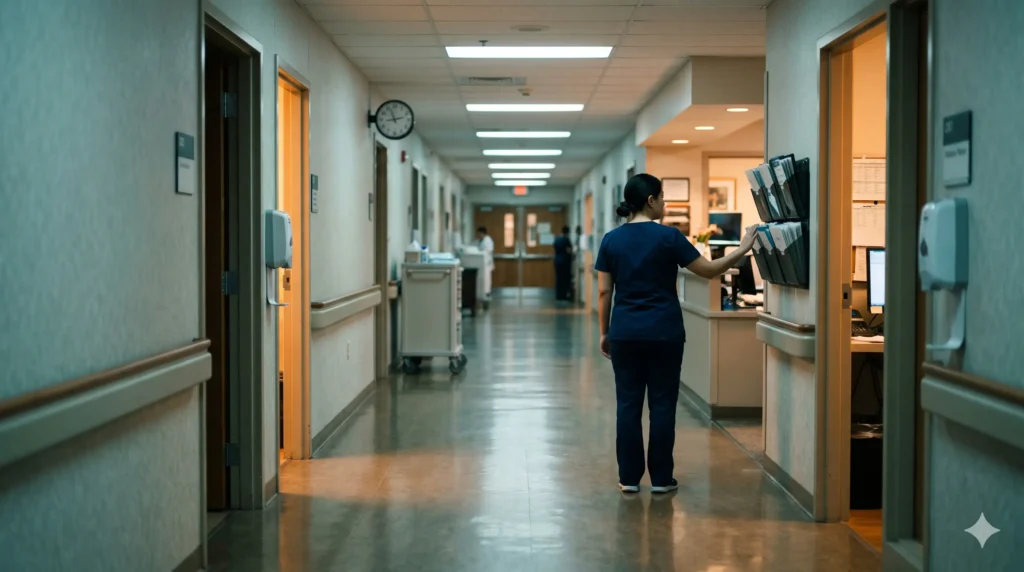
A hot rack in a nursing home is a facility’s internal follow-up charting list. A resident lands on it after a change in condition, such as a fall or a choking episode. Licensed nurses then re-chart that resident every shift until the issue resolves or the resident is stable.
It is not a Centers for Medicare & Medicaid Services (CMS) term or a federal requirement. The clearest published definition we found is in one facility’s nurse orientation manual. This guide states what that source says and where it stops.
The phrase also names a separate product at LTC Apps: our Hot Rack module for nursing assignments and physician orders. Most searchers want the first meaning. We cover both and keep them apart.
QUICK SUMMARY
A hot rack is a skilled nursing facility (SNF) list of residents who need extra follow-up charting after a change in condition. In the one published policy we found, residents stay on it for a set window, usually 72 hours or more, and nurses chart each shift. Triggers include falls, choking, abuse or neglect allegations, new skin issues, return admissions, and suicidal behavior threats. The list is facility policy, not a CMS rule. The LTC Apps Hot Rack module shares the name but organizes nursing assignments and physician orders.
Table of Contents
What Is a Hot Rack in a Nursing Home?
Hot rack is a facility-level name for a time-boxed follow-up charting list, not a regulatory category. The Arkansas Health Center’s licensed practical nurse (LPN) orientation manual, revised April 2011, describes a “Hot Rack Documentation System.” It calls for follow-up charting at least every shift until the resident’s condition resolves or stabilizes.
Residents go on a form kept in a binder at each nurses’ station.
A hot rack is a list of residents who need extra documentation right now. Each one is on it because something changed. Each stays for a set window, and the nurse on every shift reads the list and charts again. When the window closes and the resident is stable, the entry ends.
This is one facility’s policy. We found no second published source defining the term, so treat it as one facility’s label, not an industry standard.
|
|
Meaning 1: Clinical practice
|
Meaning 2: LTC Apps module
|
|---|---|---|
|
What it is
|
Follow-up charting list for residents with a change in condition
|
Software that organizes nursing assignments and physician orders by date, resident, and nurse
|
|
Where it lives
|
A form in a binder at each nurses' station
|
A software module at ltcapps.com
|
|
Source
|
Arkansas Health Center LPN manual
|
ltcapps.com/products/hot-rack/
|
Why Does a Resident Get Placed on the Hot Rack?
A change in condition puts a resident on the list, and the manual names the triggers protocol by protocol. Choking episodes, incident and accident (I/A) reports, falls, abuse or neglect allegations, return admissions, new skin issues, and suicidal behavior threats each end with a hot rack instruction.
Most of these start with an event. The I/A report documents the event once. The hot rack covers what happens after.
A hot rack entry is not a status. It is a clock with a trigger, a charting cadence, and an end condition. A list with no end condition only grows, and a list that only grows stops being read.
Audit readiness is one part of a larger program, covered in how audit-ready documentation fits into your wider compliance program.
How Long Does Hot Rack Charting Last?
The duration depends on the trigger, and the manual does not use one number. The default is 72 hours or longer, until the condition heals. Other triggers run shorter, run longer, or start with tighter charting.
|
Trigger
|
Charting cadence (per manual)
|
Window
|
|---|---|---|
|
Choking, I/A incidents, falls, abuse or neglect
|
At least every shift
|
72 hours or longer, until healed
|
|
Abuse or neglect (added step)
|
Mental-anguish documentation every 2 hours
|
First 24 hours
|
|
Return admission
|
Every 2 hours, then every shift
|
24 hours, then 3 days
|
|
New skin issue
|
Every shift
|
72 hours
|
|
Suicidal behavior threat
|
Hot rack charting, plus separate 1:1 observation
|
7 days, "not 72 hours"
|
A single number like “72 hours” flattens a policy that front-loads some triggers and extends others. Staff who remember one number will under-chart the cases that run longest. The manual sets suicidal behavior threats at 7 days.
Hot rack is sometimes described as “enhanced observation” or “intensive monitoring.” The manual describes a charting cadence. When a resident needs direct observation, it lists 1:1 observation as a separate, immediate step.
Who Owns the Hot Rack List, and Who Gets Notified?
Licensed nurses own the daily charting, and the unit supervisor owns the review. Licensed nurses review the list each shift. The registered nurse (RN) supervisor reviews it during the routine start-up to confirm assessment, notification, and documentation were done, and concerns are addressed immediately.
Notification does not come from the hot rack. It comes from the separate I/A checklist. Google’s AI summary merges the two, which makes the hot rack look like an escalation tool. It is a documentation tool.
The supervisor’s daily target list in the manual draws from four places: the 24-hour nursing report, I/A reports, the hot rack list, and telephone orders. The audits in the manual check one thing in particular: was the resident placed on the list at all?
The failure the manual audits for is omission, not poor charting. A resident who never reaches the list gets no extra charting, no supervisor check, and no record that a window ran. The person who adds the resident is the most important step in the system.
The reviewer also has to be on the schedule, which is a director of nursing (DON) problem first. Our DON guide to SNF staff scheduling covers how scheduling gaps become coverage gaps.
The Mistake Most SNFs Make With Follow-Up Charting
The mistake is treating the incident report as the control. It records the event. It does not prove follow-up. The follow-up window is where the resident’s course after the event gets documented.
Federal rules set a short clock for the event itself. Under 42 Code of Federal Regulations (CFR) 483.12(c), an alleged violation involving abuse, or one that results in serious bodily injury, must be reported immediately and no later than 2 hours. Other alleged violations must be reported within 24 hours. Injuries of unknown source are among the allegations covered, and all must be thoroughly investigated (Source: Electronic Code of Federal Regulations, 42 CFR 483.12).
A hot rack list does not satisfy any of that. It sits beside it. If your reporting is fast and your follow-up charting is a binder nobody opens, you have documented the event and lost everything after it.
A hot rack nobody reads each shift is a record of intentions. The window only protects the resident when someone checks it every time.
Is the LTC Apps Hot Rack Module the Same Thing?
No. The module shares the name and does a different job. The LTC Apps Hot Rack module is charge nurse assignment software that organizes nursing assignments and physician orders by date, resident, and nurse. It is not an incident-charting or monitoring-window tool.
It has three views: a Summary view by date, a List view, and a Resident tab. DONs can use Re-Schedule Nurse when coverage changes and Bulk Schedule Upload to load assignments in one pass.
Building a follow-up charting list is a facility policy question first. If your problem is tracking which nurse has which residents and which orders are pending, see our nurse assignment tracking software for nursing homes or the SNF operations platform guide.
For how documentation connects to survey readiness, read the SNF compliance documentation guide.
Frequently asked questions
In the policy we found, it is a follow-up charting list for residents with a change in condition. Nurses chart them at least every shift until the issue resolves or the resident is stable. It is a facility term, not a CMS term.
That manual sets 72 hours or longer for most triggers and 72 hours for skin issues. Return admissions get 24 hours of 2-hour charting plus 3 days, and suicidal behavior threats get 7 days. Your facility's policy sets your own windows.
No. CMS does not define it. The reporting rules at 42 CFR 483.12(c) apply separately and set timelines for reporting alleged abuse and injuries.
No. In the manual, 1:1 observation is a separate, immediate step for suicidal behavior threats. Hot rack is the charting follow-up that runs alongside it.
Licensed nurses review it each shift. The unit RN supervisor reviews it during the daily start-up routine.
No. The module organizes nursing assignments and physician orders. It does not manage follow-up charting windows.